
Colleyville Previous Residents by Record Era
A Colleyville past-resident search becomes more reliable when the source changes with the period. Begin with a current parcel and legal description, then move from the present instrument back through historic land, household, and archive material. No single row below confirms every fact. The table separates custody, time coverage, and the limited role each record can play in an address history.
| Source | Years It Covers | Where Held | What It Shows |
|---|---|---|---|
| Tarrant Appraisal District | Current roll; earlier online cutoff not identified | TAD public property search | Account, owner display, property address, legal description, subdivision, and georeference. |
| Tarrant County Public Search | Historical county context, 1876 to present; exact online start not located | County Clerk online index | Recorded-instrument leads, party names, document details, and legal-description searches. |
| Historic tax deed cards | 1876-1984 | Tarrant County tax deed-card system | Property-history leads to confirm against a clerk index and image. |
| Property ledgers, maps, and directories | Property ledgers 1876-1917; other series vary | Tarrant County Archives | Historic land, community, and household context with collection-specific limits. |
| Federal census | 1950 and earlier public releases | National Archives access routes | Household context in an enumeration period, not recorded title. |
| City permits and plats | Coverage dates not identified | Colleyville Community Development | Land or building action where the specific file exists; a permit is not proof of completion. |
Use the appraisal record and current deed path for a recent question. For an older address, add historic tax cards, maps, directories, census schedules, school census records, newspapers, probate, and archive material. Each source supplies one layer. An owner field does not establish who lives there, and a household record does not establish legal ownership.
Colleyville Address Records to Start With
Begin with the Tarrant Appraisal District property record. Preserve the account number, georeference, property address, property city, primary-owner display, legal description, subdivision, block, lot, and the date viewed. TAD can be searched by owner name, address, and property type. Its public result fields distinguish a property address from the owner’s mailing address. They are related locations, not interchangeable ones.
Then compare the parcel with the Tarrant GIS Public Map Viewer and the county tax account. GIS supports address, account, and owner searches, plus map layers. The map gives parcel context, while the appraisal and tax records provide separately dated administrative fields. Retain the legal description exactly as shown, including block, lot, subdivision, punctuation, and leading zeroes. That wording often survives a street-name change better than a casual address search.
Colleyville Previous Residents and Deeds
Recorded deeds establish transfers, not occupancy. For a Colleyville past-resident trail, use the current parcel facts to locate the current acquisition deed, then trace the seller backward as a prior grantee. Search both the street or situs address and the legal description. A deed can omit a modern street label, use an earlier road description, or be indexed under a subdivision and lot instead.
- Pull the current TAD account, legal description, and current owner display. Record the retrieval date.
- Find the current owner's acquisition deed in Tarrant County Public Search and preserve the instrument number, recording date, parties, and document type.
- Take the seller from that deed and search that person as a grantee to identify the earlier acquisition.
- Repeat the grantee-to-prior-grantor sequence, checking the legal description at every transfer for parcel splits, corrected deeds, or changing lot language.
- When the online index does not resolve the trail, continue in older deed books and archive material. State the gap rather than assigning an unsupported predecessor.
- Grantor
- The party conveying an interest in a recorded instrument.
- Grantee
- The party receiving that interest. In a backward deed search, a seller on one deed can become the grantee on the earlier purchase.
- Chain of title
- A documented sequence of recorded transfers or related instruments for the same legal parcel. The county does not conduct that search for a requester.
- Legal description
- The subdivision, block, lot, survey, section, condominium, or other land wording used to identify the property. It is often more durable than a street address.
Tarrant Fields for Colleyville Property Records
The county's advanced search supports department, party, grantor, grantee, recorded-date, document-type, document-number, book-volume-page, OCR phrase, and legal-description fields. Legal-description options include freeform, subdivision, section, and condominium descriptions. Search a known spelling first, then test a variant with a date range, subdivision, or document type. Record whether the result came from the index alone or from index-plus-OCR scope.
| Street or situs wording | Useful for recent instruments, but may be absent or different in older deeds. |
|---|---|
| Grantor and grantee | Party fields that move the transaction chain backward. |
| Subdivision and legal description | Stable keys when an address changed, was never printed, or appears under lot language. |
| Document number and book-volume-page | Precise retrieval fields to preserve before ordering an image or copy. |
| OCR phrase | An additional text-search lead, not a substitute for reading the image. |
Normal online viewing is generally available five to seven days after intake. The copy routes include online account access for unofficial watermarked and certified copies, mail requests with the document number, a self-addressed stamped envelope, and a cashier's check or money order, plus in-person service in Room B30. In-person copies cost $1 per page and certification adds $5. The county explicitly does not perform a title or lien search, so the requester must identify the needed instrument.
Colleyville Addresses Across Old Roads
Previous residents can be lost when a current street map is treated as the only address vocabulary. Colleyville's rural-era records may use Spring Garden, Bransford, Pleasant Run, Pleasant Glade, or a Tarrant County description because the city was incorporated in 1956. Search those historic community names beside the present street name, and compare deeds, plats, map dates, and legal descriptions before deciding that two references describe different places.
The Dee Barker material at Tarrant Archives documents a Bransford Road and Shelton Drive realignment from 1997 to 1999. It is a real warning about continuity, not evidence of a citywide renumbering. No official citywide renumbering list was located. When an older street reference does not align with a current map, write down the conflict and seek the plat or map closest to the record's date.
Colleyville Previous Residents in Census Records
Land transfers identify parties, but they do not answer every question about who lived at an address. Directories, census schedules, school census records, obituary notices, probate records, and newspapers can add household context. The available regional directory evidence and its limitations are described with the collection details on the Colleyville city directory page. A reverse directory has not been verified for Colleyville, so do not assume an address can be searched that way.
Use a short, dated process flow: legal description and parcel record → recorded deed sequence → a dated directory or newspaper lead → census or school-census household context → probate or obituary material where relevant. The National Archives release rule makes the 1950 federal census available; the 1960 census remains unreleased. A census household is still a household record, not a deed.
- Place the address and legal description on the property timeline.
- Match a directory or newspaper date to the closest available census period without treating them as the same event.
- Search Tarrant County and historical community names for material before incorporation.
- Record each person’s role exactly as the source presents it, then keep competing same-name possibilities separate.
Colleyville House-History Archives
Tarrant County Archives provides the strongest institutional fallback when a Colleyville deed or directory trail reaches older material. Historic ledger series include property records from 1876 to 1917, school records from 1896 to 1970, marriage records from 1875 to 1900, and other series with their own dates. The County Clerk archival collection covers 1874 to 2021, with most material from 1874 to 1966. A finding aid or staff request should name the address, legal description, street variant, community name, and date range.
The City of Colleyville collection includes a 1979 community appraisal survey and Colleyville Then and Now from 2006.
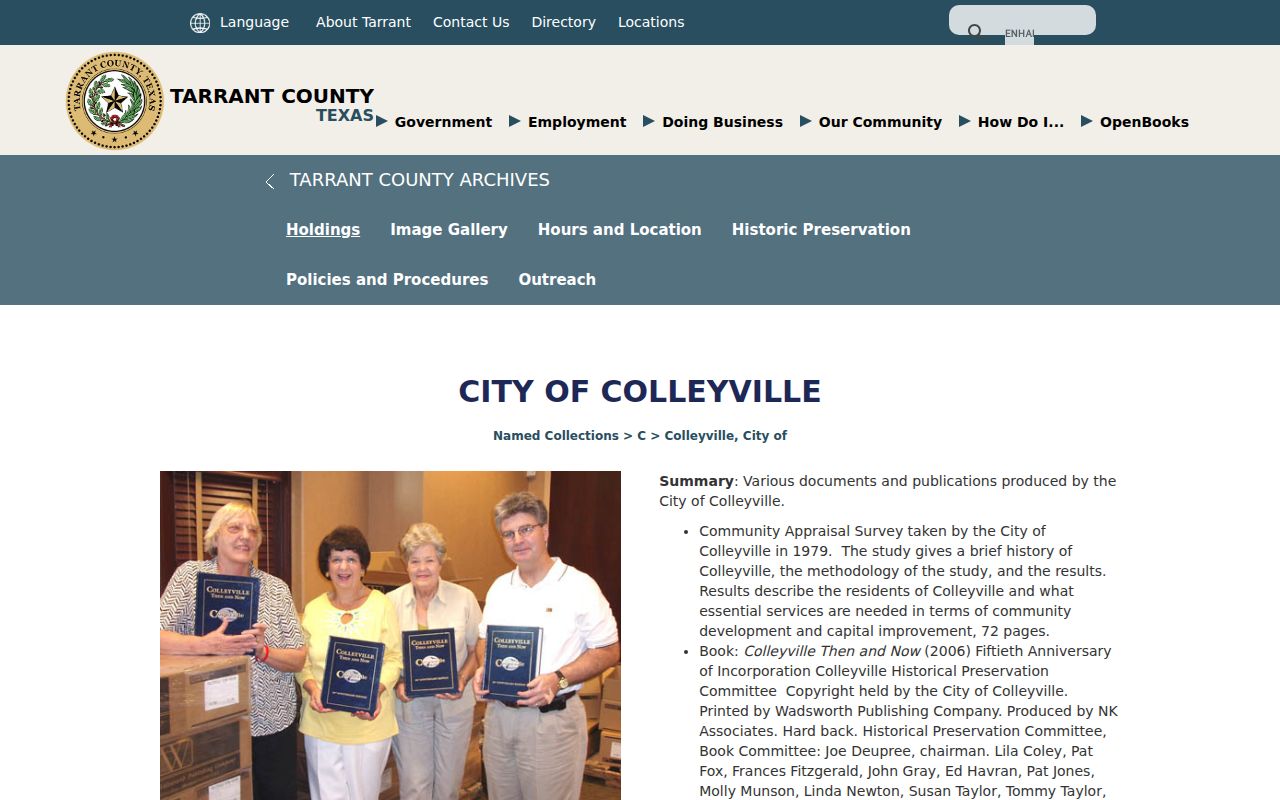
This Colleyville previous residents image identifies a local historical collection that can supply context for a place, but it does not establish who occupied an address at a particular time.
The Archives reading room is at 200 Taylor Street, Suite 5200, Fort Worth, with walk-in service Tuesday through Friday from 9:00 to 4:30 and Monday by appointment. Call 817-884-3272 before traveling. The Historical Preservation Committee collection can also supply local place history, including Colleyville: 1855-1956 and the Bidault House account.
Colleyville's 1876 Property Records Gap
The March 29, 1876 Old Courthouse fire destroyed loose pre-fire Commissioners Court papers. The loss is important because it creates a documented gap, not a reason to invent a seamless early deed trail. Later supplied copies may exist. The County Archives advises researchers that Book A is the earliest extant deed book and that older indexes can omit an instrument date.
For an early property question, use page-by-page deed-book work where an index is weak, check tax cards and historic ledgers, and preserve the negative result with the records searched. A careful note might say that a predecessor was not identified in the examined sources, rather than turning an absent index entry into proof that no transaction occurred.
Colleyville Previous Residents Source Dates
Keep a timeline with a separate line for conveyance, construction, occupancy, community naming, and municipal action. A permit date is not a completion date unless the document says so. A directory line is not a deed. A current owner display is not evidence of a current household. These distinctions let a Colleyville previous residents record remain useful even when a later document changes the story.
Lawful personal research. Use a Colleyville past-resident trail for family history, estate and heir work, property history, or personal curiosity. Do not use a record trail to track, contact, stalk, harass, or harm a living person.
For a city-held document that is not already posted, a focused written request under the Texas Public Information Act should identify the address, account, legal description, record type, date range, and preferred format. Specific requests can be mailed, faxed, emailed, or delivered in person. The state guidance calls for prompt production of non-exempt information or a written status notice when it cannot be ready within ten working days.