
Colleyville Neighbors by Block
The most defensible block view separates land records, city geography, association records, and civic information. GIS and TAD can locate the parcels surrounding an address, while deed and plat records can explain a lot, block, subdivision, or instrument. A public owner label is not proof of who occupies the property. For Colleyville neighbors, preserve the source type and do not merge these records into a household roster.
| Source | What It Shows About a Block | Access |
|---|---|---|
| Tarrant GIS | Target parcel, surrounding shapes, streets, creeks, and map layers | Public viewer with address, account, and owner searches |
| TAD | Current appraisal owner label, situs, mailing address, account, and legal description | Public search; owner label is not resident proof |
| Deed and plat index | Instruments, legal lots, subdivision terms, and recorded land context | County index and clerk copy routes |
| City map and permits | Street, creek, planning context, permit categories, and year-linked documents | City map and city document routes; no complete interactive schema captured |
| HOA certificate search | Association name, county, city, ZIP, type, and certificate PDFs | State search; not a member list |
| Voter file | Regulated registration and precinct information | Individual lookup or formal request, never a block roster |
| Civic-group page | Published organization and meeting context | City page; no private membership roster |
A mailing address may be outside Colleyville while the situs remains in the city. The legal description can also omit a current street number. That is why a property record may verify a parcel relationship without saying who lives there. Utility customers, motor-vehicle records, and household members are not a public block database.
Map Colleyville Neighbor Parcels
Use the map as a parcel-by-parcel method. The Tarrant County GIS Public Map Viewer supports address, account, owner, and layer controls. Its observed public interface did not confirm a buffer, radius, export, or automatic adjacent-parcel command. Instead, zoom into the target, inspect visible borders, road edges, and creek edges, then open nearby records individually.
- Find the target in the GIS viewer using the address, account, or owner search that fits the known record.
- Zoom to the parcel boundary and identify the bordering parcel shapes. Note whether a road, creek, or other mapped edge interrupts a direct border.
- Open each nearby Tarrant Appraisal District detail separately. Record the account, legal description, owner label, situs, and mailing fields as distinct facts.
- Check the county deed or plat index when a block, lot, subdivision, or instrument needs clarification. Keep a recorded land relationship separate from current occupancy.
This is a bounded way to understand immediate Colleyville neighbors. A full named-street record chain is handled by the Colleyville street directory, where address-oriented sources can be followed farther along a road.
Colleyville Neighbor GIS Limits
A map layer is a geographic clue, not a residence claim. TAD lists property address and city as situs fields and can show a primary owner name, but the same record may give a different mailing address. The county tax search can add account and correspondence context, while the county recorder index supplies recorded instruments. Each source answers a different question, and neither a mailing field nor a map pin should be restated as proof that a person lives at the site.
Compare the city map only for city-level features such as streets, streams, parks, schools, churches, and offices. Use a recorded plat, legal description, or deed image for a boundary claim. Subdivision phases, amended plats, and replatting can mean that an association name, city neighborhood label, and legal subdivision do not match. Note: Preserve the map date and source whenever a nearby boundary is material to the question.
City permit pages add a separate municipal-action layer. The reviewed Colleyville material identifies permit categories and year-specific documents, but it did not establish a complete interactive search-field schema or an occupancy record. A permit can help date a local action at a parcel. It does not establish a completed project, a current owner, or a list of neighbors.
Colleyville Neighborhood Names Differ
Colleyville's six planning areas use HOA service areas, major streets, railroads, and creeks as boundary clues. That geography helps explain why a subdivision name in TAD can differ from a broader local neighborhood description. The early community names Spring Garden, Bransford, Pleasant Run, and Pleasant Glade can also surface in older records. They are historical search terms, not evidence that a modern address belongs to a particular group.
The city incorporated in 1956, so older county records may carry rural community labels. This numbers-based local detail is useful when a current street reference seems absent from an archive or plat. Match the record's date, map, and legal description before joining it to a modern Colleyville parcel.
Colleyville Neighborhood Association Records
The city residents page points to HOA and CC&R information, but it does not publish a full neighborhood or member directory. The Texas HOA management-certificate search is a more specific official route. With Tarrant County selected, its results show an association name, county, city, ZIP, type, and management-certificate PDFs. A row identifies an association filing, not members or a complete list of Colleyville neighbors.
The official management-certificate search is shown with sample Colleyville results.
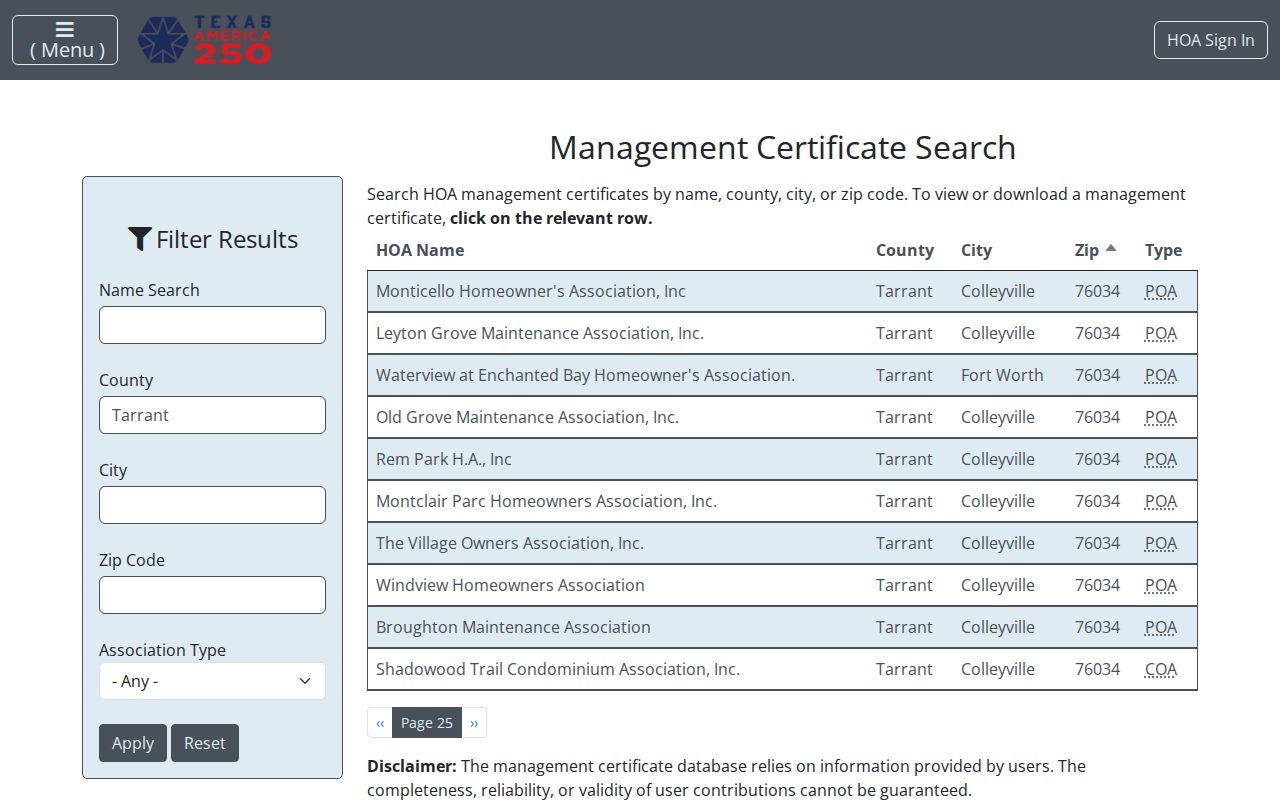
The recorded examples include Rosewood Villas, Carmel Place Estates East HOA, Whittier Heights HOA, L T Estates HOA, Preservation HOA, Villas at Colleyville HOA, Colleyville Spring Garden Townhomes, Heritage Gateway Office Condominiums, Villas of Windsor Steele, and Cambridge Place. The search is not exhaustive, and its results never identify association members.
For a subdivision question, compare three labels where the sources provide them: TAD's legal subdivision, the county plat or deed index term, and the city planning or neighborhood label. A match between names can be useful. A mismatch may simply reflect an amended plat, a phase, replatting, or a separately named association.
Colleyville Neighbor Group Context
The city's community-groups page supplies public meeting context without a roster. It lists Garden Club, Lions, Library Foundation, Rotary, Woman's Club, Northeast Leadership Forum, and Friends of the Library. Garden Club meets at 5301 Riverwalk on the first Wednesday from September through May. The Lions Club was chartered June 1, 1982, reports about 200 active members, and meets at 6605 Pleasant Run.
Friends of the Library began in July 1991. These are useful historical and civic landmarks, not identity shortcuts. A person might appear in a dated public program, but that does not establish current membership, a home address, or a relationship to nearby parcels. Ask the organization directly only for its published contact information or history.
Colleyville Neighbor Record Comparisons
Official systems explain what a record means and who maintains it. Commercial neighbor-tool categories can combine datasets, but a combined display may be stale, incomplete, or match the wrong person. For an address question, use the official map, property record, deed image, or city document that fits the exact issue. For a civic question, use the group page or association certificate only for the role it documents.
| Official record route | Commercial neighbor-tool category |
|---|---|
| States its custodian, source field, and record purpose | May combine data with changing provenance and matching rules |
| Lets a researcher separate owner label, parcel, plat, and civic role | Can blur those roles into a single person display |
| Provides an agency correction or redaction route | May use a separate removal process and retain stale matches |
County property-fraud monitoring is another narrow official tool, not a neighbor directory. The Tarrant County property-fraud alert page explains its name-monitoring enrollment and limitations.
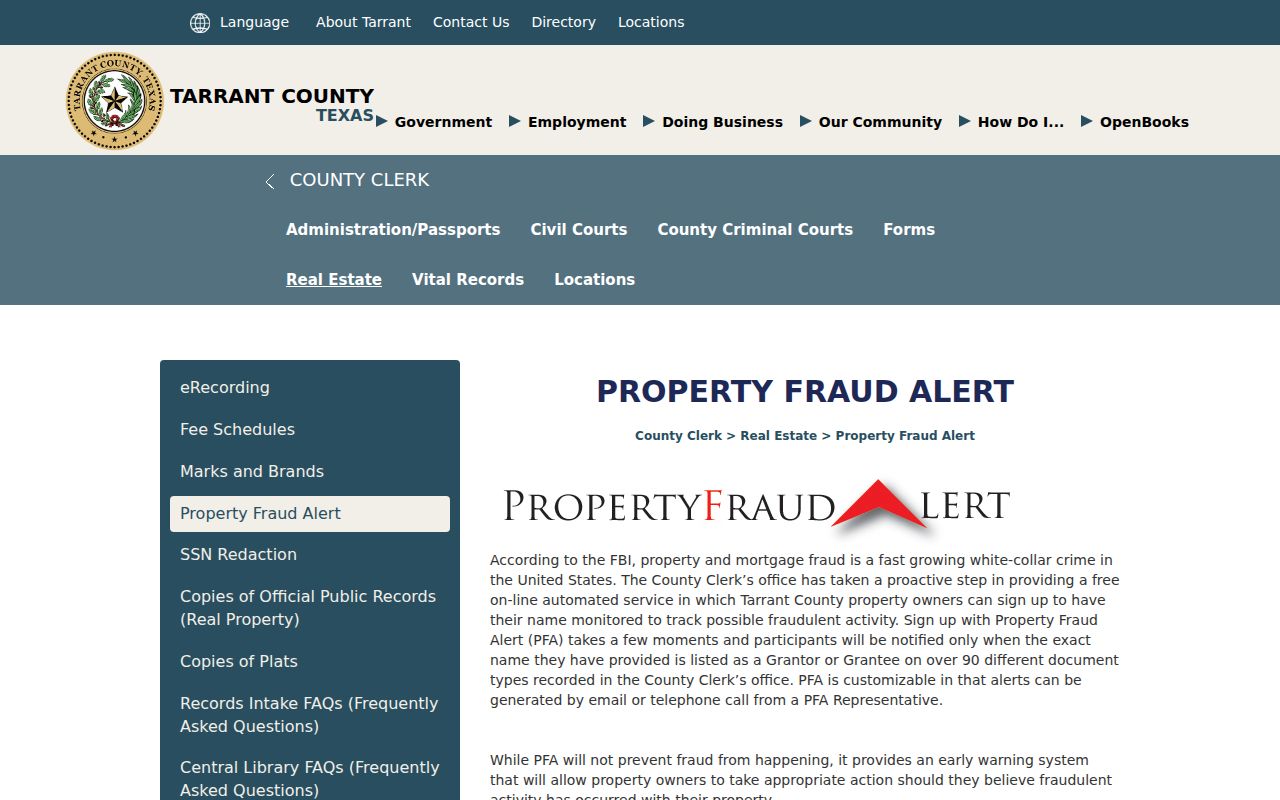
The free alert watches a name as grantor or grantee across more than 90 document types, but it warns early and does not prevent a fraudulent filing. It says nothing about who occupies nearby parcels.
Colleyville Neighbor Record Requests
A Texas Public Information Act request should be specific and record-centered. It may be sent by mail, fax, email, or in person without giving a reason. For a Colleyville address, identify the street address, TAD account, subdivision block and lot, document number, record type, date range, and preferred format. Request a permit, plat, certificate of occupancy, council item, resolution, or code document rather than asking for everything about people around an address.
The city should promptly release non-exempt information or send written notice within ten working days when it needs more time. It must provide a cost estimate when expected charges exceed $40. Check the city public-documents route first, then use the county clerk's deed index for a known land instrument. A voter-file request is regulated and requires the state process, not a casual request for a block list.
Colleyville Neighbors Privacy Limits
No official household master list was located for Colleyville. Renters and household members are not reliably indexed through property records, utility records are not public, and driver information is restricted. The city voluntary address registry for No Knock or Solicitors Welcome is an address-only service registry, not proof of occupancy. Its absence does not prove that no one is present, and its presence does not identify a resident.
The voluntary registry requires a valid email and lists street addresses only. Directional information can be blank, and the city updates the lists until removal. It can explain why an address appears in a city service list, but it is neither a census, a voter roll, an HOA directory, nor an invitation to infer who lives there.
Texas Address Confidentiality protections and protected voter information must be honored. Do not attempt to defeat a suppressed address, identify a protected person through neighboring records, or republish sensitive details. A narrow parcel search can serve a personal safety, civic, or property-curiosity question without exposing someone else's private information.
Lawful use. Use Colleyville neighbor records only for lawful personal research and respect protected addresses. Texas Penal Code §§42.07 and 42.072 address harassment and stalking.