
Finding Colleyville Residents
No single public household roll exists for Colleyville. So the practical route depends on the question. An address usually starts with the Tarrant Appraisal District roll and the county map. A property relationship can then lead into the county deed index. A name tied to a municipal matter belongs with the right court. It does not sit in a land record. A past household is often easier to place through the Archives. The library, a regional directory scan, or census material can also help. Keep the source date and record role with every result.
Start small. One matched parcel, document number, precinct result, or archive citation beats a broad name list. An owner field proves ownership, not occupancy. A directory listing proves only what a publication printed at that time. Strong Colleyville residents directory work compares two independent details. Only then treat same-name records as one person.
- Search the address or owner label in the property roll and note the account, legal description, and property city.
- Open the map record to compare the parcel shape, nearby roads, and the displayed address or account.
- Use the deed index by party, subdivision, document type, or legal description when a recorded land trail is needed.
- Use the voter route only for regulated registration and precinct context, never to create a household list.
- For older Colleyville residents, ask the library or Archives for a specific directory, ledger, map, or census lead.
Colleyville Resident Records Offices
Colleyville sits in Tarrant County, and Fort Worth holds the county seat, so most records behind a Colleyville residents directory live at the county or state level. The city itself supplies municipal documents, permits, map context, and a shared municipal court. The clerk preserves instruments and county record series. The appraisal district provides the current property-roll view. Elections handles registration and precinct administration. Go to the office that owns the record, and save its record type and retrieval date.
Tarrant County Clerk, Real Estate
100 W Weatherford Street
Fort Worth, TX 76196
817-884-1195
Tarrant Appraisal District
Property account, owner-label, and legal-description research
Current online coverage date not stated
Use the official property portal
City records form a separate channel. The Colleyville City Secretary custodies council material, and department pages add planning, permit, and public-document context.
Colleyville Parcel Record Search
For a Colleyville address, the appraisal roll is often the first official record worth checking. Its public search takes a free-text query plus a property type. Results can show an account number and a georeference. They can also show the property address, property city, primary owner name, and market value. A detail record may add the legal description, subdivision, map references, and jurisdiction rows. It may also add owner mailing information. Keep the property address and the mailing address separate in your notes.
That distinction guards against a common error. A mailing address may belong to a trust. It may belong to a lender, a business, or an owner living elsewhere. Market value is an appraisal figure, not a sale price. The parcel is a precise Colleyville clue. It is no census of everyone at the address, though. After identifying the parcel, the address-focused Colleyville street directory route handles whole-road sequences.
| Observed TAD field | How it helps |
|---|---|
| Property type and search query | Starts a residential, commercial, mineral, or personal-property search. |
| Account and georeference | Provides stable follow-up keys when a street spelling changes. |
| Property address and city | Identifies the situs location shown in the appraisal record. |
| Primary owner and market value | Labels the appraisal relationship and value, not current residency or sale price. |
Colleyville Deed Index Fields
The Tarrant County Clerk's official index is the recorded-instrument layer of the Colleyville residents directory. Quick Search accepts a grantor or grantee, subdivision, document type, or document number. Date presets and index or OCR scope round out the form. Advanced Search layers on departments, party fields, document ranges, and book-volume-page. Image and OCR phrases come next, along with legal-description choices. Search a person as grantor and grantee separately. Then compare the legal description against the appraisal parcel.
Treat a recorded result as a lead. It is never a title opinion or proof of current ownership. The county states plainly that it performs no title or lien search for requesters. When a document matters, pin it down by document number, date, party, or legal description. Obtain the underlying image or certified copy through the official route. The official Tarrant advanced-search screen shows party, department, document, and book-volume-page fields. OCR and legal-description fields appear there too.
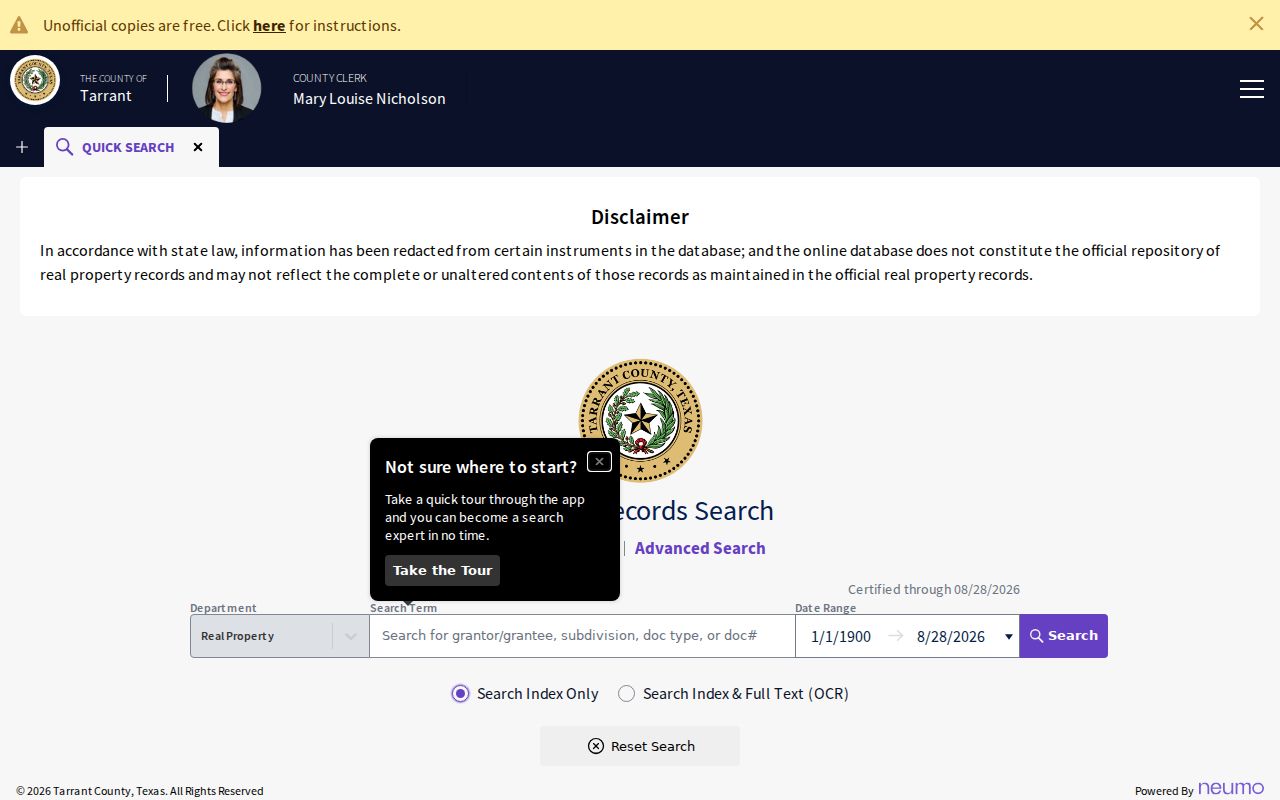
Those field choices let you narrow a common name with a recording date, subdivision, or instrument reference. Never assume the first result belongs to a Colleyville resident.
- Roll
- An agency list or data view organized for its own purpose, such as appraisal or election administration.
- Index
- A finding tool that points to a recorded item. It is not always the full document image.
- Parcel
- A mapped piece of land tied to an account, legal description, and sometimes a street address.
- Criss-cross directory
- A reverse-address directory format, if a verified volume can be located.
Current Colleyville Resident Directories
Current directory-like sources each identify a different role. The property roll names an appraisal owner. The tax system adds account and payment context. Voter tools may return registration and precinct information under election rules. A deed index names parties to recorded instruments. A city document can name a public applicant, contact, or parcel. None of these should be relabeled a complete current household directory.
| Record route | Role it can show | Custodian | Access channel |
|---|---|---|---|
| Property and tax roll | Account and owner-related parcel label | TAD and Tax Office | Public online search |
| Voter lookup | Registration and precinct context | Texas SOS and Tarrant Elections | Individual lookup or regulated request |
| Official-record index | Grantor, grantee, and other instrument parties | Tarrant County Clerk | Online index, mail, account, or counter |
| City public documents | Public administrative role or parcel reference | City of Colleyville | Portal or narrow records request |
| HOA certificate search | Association identity and certificate record | Texas HOA system | Public state search, not a member list |
If the goal is one person rather than a record role, compare at least two independent elements. The more focused Colleyville resident lookup workflow helps there.
Colleyville Voter Record Limits
Texas runs its individual voter lookups through the My Voter Portal. You can sign in with a VUID and date of birth. A driver-license number with a date of birth also works. The state must have one on file. A third path combines name, county, date of birth, and ZIP code. The portal shows only your own record. Expect field prompts rather than a browsable Colleyville voter roll. A lookup may fail to match. A record may also be protected. Tarrant Elections can explain the situation through its official channels.
Keep the categories straight. Registration status, precinct, districts, and polling places are public participation facts. Your actual ballot choices stay private. Texas law can expose parts of the voter file in defined contexts. Social Security numbers, driver-license data, and protected addresses remain restricted. A broader voter-file request needs the state form, a notarized affidavit, chosen filters, and contact details. It also requires a stated deposit.
Note: A missing voter result may reflect privacy protection, spelling, timing, or jurisdiction. That is not proof that a Colleyville person is absent.
Colleyville Public Documents By Address
The city's Public Documents page gathers council packets, minutes, ordinances, resolutions, budgets, maps, planning material, certificates of occupancy, and a police accident-report database. These are administrative records, not a resident roll. An agenda can name an applicant. A resolution can cite a parcel. A certificate can tie a building to paper. But none of these proves who lives at an address.
Start with what the city already publishes. Anything missing can be requested in writing under the Texas Public Information Act. You can submit it by mail, fax, email, or in person. Name the address, account, subdivision or Block/Lot. Also give the record type, a date range, and the format you want. The agency must release non-exempt material promptly. Or it can send written status within ten working days if it needs longer. Expect a written estimate when charges will likely top $40.
Permit pages organize documents by category and year, covering 2022 through 2026. The city publishes no interactive permit search fields. So request a permit or locate it by exact document title and year.
Colleyville Historical Directory Sources
For past Colleyville residents, the best digital lead is the regional directory collection at the Portal to Texas History. One scanned Greater Dallas White Pages page from 1985/1986 lists Colleyville civic and business entries. The printed names, street wording, and telephone numbers appear as published. Treat it as a dated snapshot. It is not a residential roster, and no one should present it as one.
The Colleyville Library's digital-resources page offers a catalog, e-newspapers, e-books, and databases. Access depends on your library card or location. Tarrant County Archives adds historic maps, city-directory research, marriage records, school census, probate abstracts, and finding aids. Before assuming a Colleyville-specific directory run exists, ask for the title, year, call number, and access rule.
Any regional scan work should record the volume, date, and page. Distinguish a verified business page from an unverified residential run.
Historical Colleyville Resident Directories
Older records often carry place names that predate the city itself. Colleyville was incorporated in 1956. Before that, families were logged under Spring Garden, Bransford, Pleasant Run, and Pleasant Glade. Some entries simply say rural Tarrant County. All of these are valid search variants. Pair them with a family name, a road variant, a subdivision, or a legal description. A modern city-name search alone can miss a household recorded under an earlier community label.
Tarrant County Archives holds more than 600 collections. It also runs a reading room at 200 Taylor Street, Suite 5200 in Fort Worth. Its genealogy holdings include marriage records from 1876 to 1901, school census from 1919 to 1970, historic maps, and city directories. Early probate abstracts round out the collection. The Archives genealogy holdings work as both an online finding aid and a request route. So ask for the collection or box before visiting.
Colleyville's 1876 Records Gap
Tarrant County's older record trail has a genuine break, and it matters for Colleyville history. The Old Courthouse fire of March 29, 1876 destroyed loose pre-fire Commissioners Court papers. Later supplied copies were sometimes transcribed or certified rather than original. County Archives series still reach back into the nineteenth century. Each one starts and ends differently. A gap in a surviving series proves nothing about a person, family, or parcel.
For early property research, start with Book A when the index is weak. Page through deed books where needed. Log the series searched, the date range, the spelling, and the gap itself. Tarrant's archival County Clerk material runs from 1874 to 2021. Most of it is dated 1874 to 1966. The city's rural predecessor communities matter most on this older Colleyville trail.
Colleyville ZIP 76034 Limits
ZIP 76034 anchors Colleyville on paper. The official Tarrant County ZIP and voting-precinct map, effective January 1, 2024, assigns that code to the city. That works well for map and election geography. It settles nothing about postal-city limits, though. A single code does not guarantee every municipal delivery address carries it, and it will not resolve a mailing-address or parcel-boundary question on its own.
The state's administrative-order search deserves the same caution. It is a Texas licensing tool, and it can search by city, county, and ZIP. It holds no parcel data. Property work in Colleyville belongs with TAD, the Tax Office, and GIS, which match records by address, account, or owner. The official screen for the state administrative-order search shows a ZIP-capable field kept in its proper record context.
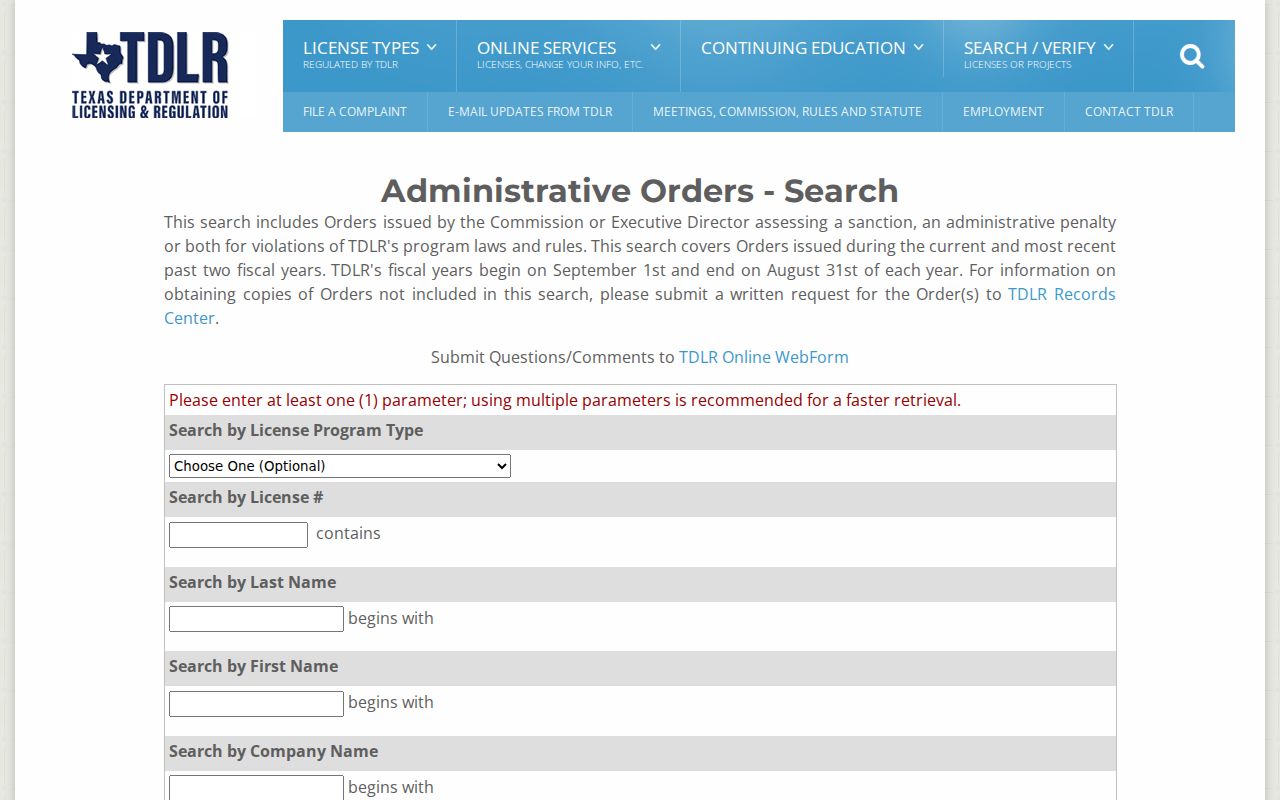
Skip borrowed codes entirely. To confirm a delivery ZIP in Colleyville, validate the exact address with USPS and keep a dated note of that lookup rather than trusting a license or map result.
Colleyville Civic Record Roles
Community records add local color, but none of them doubles as a people finder. The city steers residents toward HOA and CC&R information. The state HOA certificate search goes further. It lists an association name, county, city, ZIP, type, and its management-certificate document. It never names members. Colleyville community-group pages spotlight the Garden Club, Lions, Rotary, Woman's Club, Library Foundation, Friends of the Library, and Northeast Leadership Forum. None publishes a roster.
Role words matter here. A party on a deed may not own the property today. A license record can point to a business or practice address. An association contact is not a member list. Handled with that care, a Colleyville residents directory supports family history, civic transparency, property curiosity, and fraud prevention. It does this without stretching partial records into claims about private lives.
Tarrant County adds a free property-fraud alert that watches a name as grantor or grantee. It covers more than 90 document types. Think of it as an early-warning system. It is not proof of fraud. It also cannot replace a look at the indexed instrument itself. When an alert arrives, pull the exact document image, note the recording date, and use the county clerk's copy route. The county runs a separate notary-commission monitoring service too. Both safeguards strengthen a property trail, yet neither reveals who lives at a Colleyville address.
| Official record | Best use | Do not infer |
|---|---|---|
| Appraisal or tax record | Parcel and owner-label context | Every current household member |
| Recorded instrument | Document party and land transaction trail | Current title without checking later records |
| HOA certificate | Association and management-certificate context | Association membership or residence |